

Introduction
Luno is expanding its regulated international footprint after securing a Class F Digital Asset Business licence from the Bermuda Monetary Authority.
The licence gives Luno International Ltd a regulated base outside the company’s core African and Asia-Pacific markets. More importantly, it provides the regulatory foundation for Luno to expand its institutional and business-to-business services globally.
The development marks a strategic shift for a company that has spent more than 13 years building its retail and institutional digital-asset operations across emerging markets.
What the Class F licence means
Bermuda introduced its dedicated digital-asset regulatory framework through the Digital Asset Business Act 2018.
The Bermuda Monetary Authority currently provides three categories of Digital Asset Business licences:
- Class T for businesses testing a digital-asset product or service
- Class M for companies operating under a modified licence for a defined period
- Class F for established businesses seeking full authorisation
A Class F licence is Bermuda’s full digital-asset business licence. Depending on the specific permissions granted, it can cover digital-asset exchanges, payment services, custody, wallet services, token issuance, trust services and digital-asset derivatives.
Unlike the temporary or transitional licence categories, Class F is intended for companies operating established digital-asset businesses under ongoing regulatory supervision.
Luno’s licence authorises the company to provide three principal service categories:
- Over-the-counter trading
- Global spot-market access
- Digital-asset wallet infrastructure
Supporting Luno’s institutional expansion
The Bermuda licence follows Luno’s restructuring around three focused business lines and is intended to support the expansion of its Crypto as a Service and Global Settlements offerings.
Through Crypto as a Service, financial institutions and other businesses can integrate digital-asset capabilities without having to develop every component of the underlying infrastructure independently.
Global Settlements is positioned around the movement and settlement of value across borders. A regulated base in Bermuda could help Luno serve partners outside its established African and Asia-Pacific markets while operating within a jurisdiction specifically designed for digital-asset and modern-payment businesses.
The licence therefore represents more than geographic expansion. It supports Luno’s transition from a primarily consumer-facing crypto platform into a broader digital financial-infrastructure provider.
What Luno can offer under the licence
Luno says its Bermuda operation will provide over-the-counter trading across several asset categories, including cryptocurrencies, tokenised stocks and commodities.
The offering will also include ZARU, a rand-backed stablecoin developed for institutional use and issued by Luno’s sister company, BlockTower.
ZARU introduces a South African rand-denominated settlement asset into Luno’s institutional offering. Its inclusion could be relevant to businesses seeking blockchain-based settlement while maintaining exposure to the rand rather than a dollar-denominated stablecoin.
Luno International will also offer access to global spot markets across the company’s range of tradeable digital assets.
The third component is wallet infrastructure for the secure custody and transfer of digital assets. This capability is particularly important for banks, fintechs and other businesses that want to provide digital-asset services without building their own custody and wallet systems from the ground up.
Bermuda’s regulatory significance
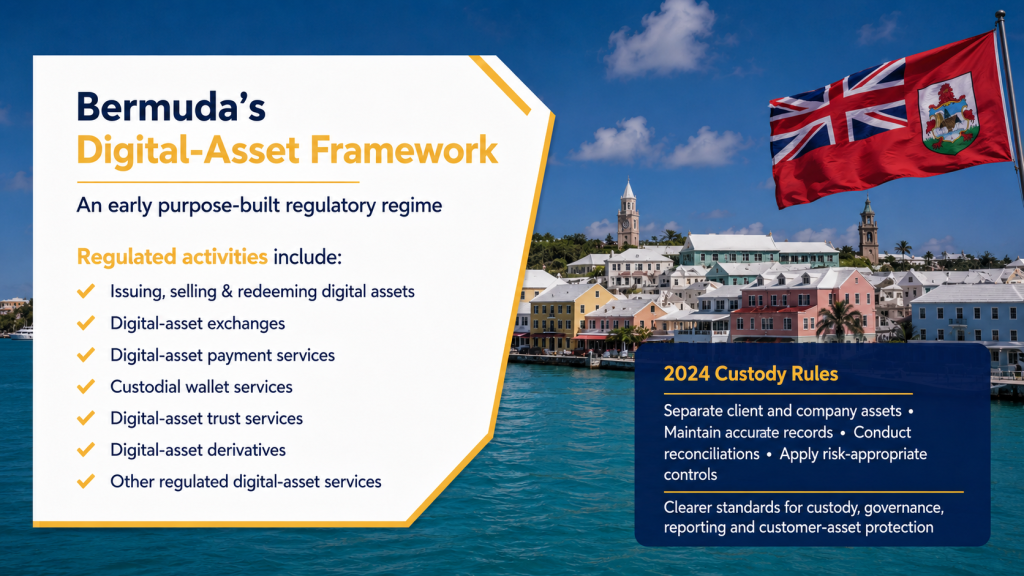
Bermuda was among the earlier jurisdictions to introduce legislation specifically governing digital-asset businesses.
The Bermuda Monetary Authority’s framework covers activities including:
- Issuing, selling and redeeming digital assets
- Operating digital-asset exchanges
- Providing digital-asset payment services
- Offering custodial wallet services
- Providing digital-asset trust services
- Operating digital-asset derivative exchanges
- Supplying other regulated digital-asset services
The framework also establishes requirements for businesses holding customer assets. Bermuda’s 2024 custody rules require licensed digital-asset businesses to separate client assets from company assets, maintain accurate records, conduct reconciliations and implement controls appropriate to the nature and complexity of their operations.
These obligations make the licence commercially significant for institutional customers, which generally require clear standards for custody, governance, reporting and customer-asset protection before integrating digital assets.
A bridge between African infrastructure and global markets
Luno describes the Bermuda authorisation as an extension of the regulatory and security approach it has followed while serving millions of customers over more than 13 years.
For the African digital-asset market, the licence demonstrates how companies established in emerging markets are building regulated infrastructure capable of serving international institutions.
The development could also strengthen the connection between African financial markets and global digital-asset liquidity. Luno can now combine its experience across African markets with a regulated international base supporting OTC execution, spot trading, custody and cross-border settlement.
The licence does not remove the risks associated with cryptocurrencies, tokenised assets or stablecoins. Institutional clients must still assess market, liquidity, custody, counterparty and regulatory risks in each jurisdiction.
However, it gives Luno a clearer regulatory platform from which to expand its institutional operations and compete for global B2B customers.
As digital assets move from retail trading towards regulated payment, settlement and treasury infrastructure, Luno’s Bermuda licence positions the company to participate in that transition beyond its traditional geographic markets.