
Introduction
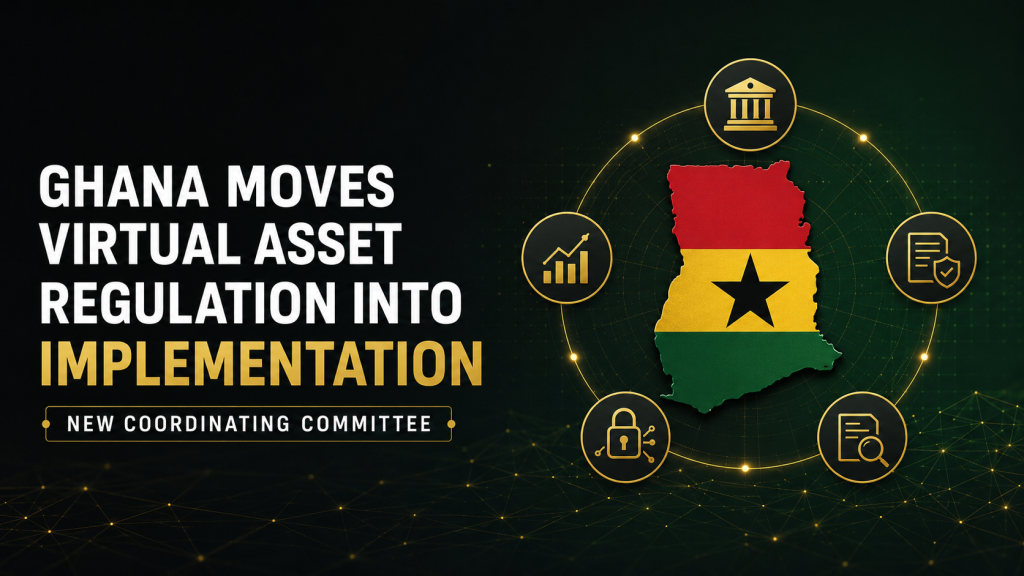
Ghana has inaugurated a seven-member Virtual Assets Coordinating Committee, marking the country’s transition from legislation to the practical implementation of the Virtual Asset Service Providers Act, 2025 (Act 1154).
The committee was inaugurated in Accra on 25 August 2026. The government is targeting 2027 for the full operationalisation of the Act as the Bank of Ghana and Securities and Exchange Commission finalise regulatory guidelines and test proposed requirements through policy sandboxes.
Ghana’s regulatory rollout in numbers
The scale of the implementation programme can be summarised through six figures:
- One law: The Virtual Asset Service Providers Act, 2025.
- Five institutions: The Bank of Ghana, SEC, Ministry of Finance, Cyber Security Authority and Financial Intelligence Centre.
- Seven committee members: Two each from the Bank of Ghana and SEC, with one representative from each of the other three institutions.
- Twenty sandbox participants: Companies and public institutions testing virtual-asset products under SEC supervision.
- Six activity categories: Tokenisation, brokerage, exchanges, commodity exchange services, real-world asset custody and trading platforms.
- One implementation target: Full operationalisation by 2027.
These figures show that Ghana is not relying on legislation alone. The country is building a multi-agency supervisory structure while collecting operational data from live virtual-asset pilots.
Twenty companies are testing the framework
The SEC’s regulatory sandbox commenced in March 2026. An updated notice published on 19 August identified 20 participating entities.
The pilots are distributed as follows:
- Five companies are testing the tokenisation of gold, securities, Treasury bills, bonds and trade-finance assets.
- Three companies are piloting virtual-asset brokerage services.
- Four companies are testing general virtual-asset exchanges.
- One company, Ghana Commodities Exchange, is testing a commodity-focused virtual-asset exchange.
- One institution, the Ghana Gold Board, is piloting real-world asset custody for gold.
- Six companies are testing virtual-asset trading platforms.
The participating entities include Yellow Card Ghana, WhiteBIT Ghana, KoinKoin Ghana, Hyro Exchange, Africoin Ghana, Ghana Commodities Exchange and Ghana Gold Board.
Data collected through the sandbox will be used to validate and finalise Ghana’s activity-specific licensing and registration rules.
Why five institutions are involved
Virtual assets cut across several areas of regulation. Stablecoins can function as payment instruments, exchanges may offer investment and custody services, while tokenisation platforms can issue blockchain-based representations of securities and physical assets.
The committee therefore combines the mandates of:
- Bank of Ghana: Payments, stablecoins, banking relationships and financial stability.
- Securities and Exchange Commission: Exchanges, tokenisation, investment products and investor protection.
- Ministry of Finance: National policy and institutional coordination.
- Cyber Security Authority: Cybersecurity, technology resilience and digital threats.
- Financial Intelligence Centre: Money laundering, terrorist financing and financial intelligence.
The committee will harmonise implementation of Act 1154, strengthen information sharing, monitor regulatory gaps and coordinate responses to consumer-protection, cybersecurity and financial-stability risks.
The 2024 risk assessment behind the law
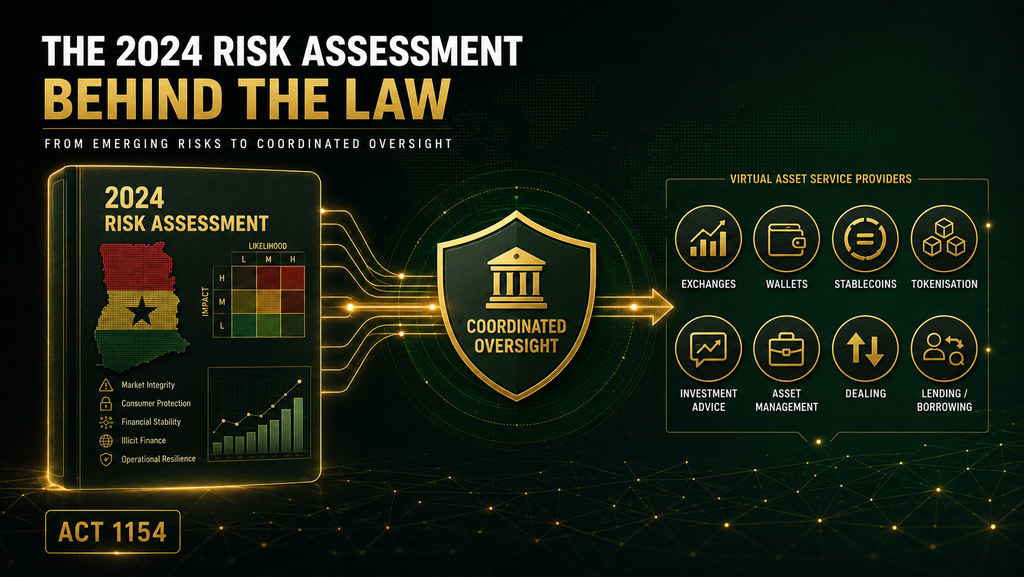
Ghana’s regulatory framework followed its 2024 national Anti-Money Laundering, Counter-Terrorist Financing and Proliferation Financing risk assessment.
The assessment identified significant virtual-asset adoption and growing connections between digital assets and the formal financial system. This highlighted the need for coordinated oversight rather than separate interventions by individual regulators.
Act 1154 now covers a broad range of activities, including exchanges, wallets, stablecoin issuance, tokenisation, investment advice, asset management, dealing, and crypto lending and borrowing.
What happens next
The committee’s inauguration does not mean that the entire licensing system is already operational. The Bank of Ghana and SEC are still developing the detailed rules governing applications, compliance, reporting and supervision.
However, businesses serving Ghanaian customers should begin preparing for activity-specific licensing, customer verification, transaction monitoring, cybersecurity, consumer disclosures, asset-protection measures and regulatory reporting.
The central implementation challenge will be converting the committee’s mandate and sandbox findings into clear rules that are consistently enforced.
The bottom line
Ghana’s virtual-asset framework now combines one principal law, five coordinating institutions, seven committee members, 20 sandbox participants, six categories of live pilots and a 2027 implementation target.
The numbers point to a regulatory strategy built around coordinated supervision and evidence from operational testing.
If Ghana successfully translates the sandbox data into clear licensing requirements, it could establish a credible virtual-asset market while protecting consumers, financial integrity and financial stability.