
Introduction
A new partnership announced this week is worth paying attention to if you’re tracking where stablecoin infrastructure is actually landing on the continent, not in pilots aimed at remittances, but in trade finance.
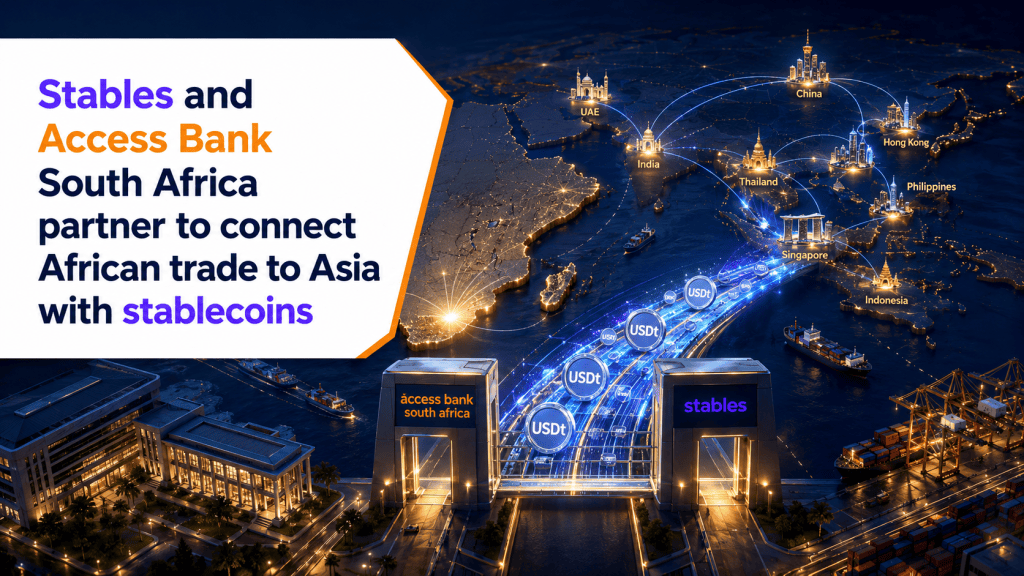
Access Bank South Africa and Stables, a USDt-native payments infrastructure provider focused on Asia and MENA, have entered an exploration phase to look at how South African businesses could settle cross-border trade with Asian partners using stablecoins instead of the traditional correspondent banking chain. Nothing has launched yet, this is a joint evaluation, and any resulting product will need regulatory sign-off before it reaches the market.
Why this corridor, and why now
Most of the stablecoin conversation in Africa has centered on two things: remittances and access to dollars. This deal points somewhere else, the physical trade lane between Africa and Asia, which has grown steadily as China has become Africa’s largest trading partner and markets like India and the UAE have become central to African import and export flows.

The problem isn’t the trade itself. It’s the money behind it. A South African importer paying a supplier in Shenzhen, Mumbai, or Dubai is often waiting several days for funds to clear a chain of correspondent banks, absorbing FX spreads and fees that aren’t always visible until settlement. In short: the goods move faster than the payment.
What each side brings
Stables operates a payments network with reach across Singapore, Hong Kong, India, Indonesia, Thailand, the Philippines, China, and the UAE, offering a single API for stablecoin collection, settlement, and payout. Access Bank brings the South African customer base, local licensing, and regulatory standing needed to actually operate in that market. Put together, the pitch is that a South African business gets a route into Asian markets without stitching together separate banking relationships in each country.
The settlement currency in question is USDt, value moves in stablecoin form and converts to local currency at each end of the transaction.
The mechanics of what’s being tested
Traditional cross-border payments route through several correspondent banks in sequence, and each one adds time, cost, and reduces visibility into where the money actually is. Settling in USDt collapses that chain: value can move on public blockchain rails continuously, then convert to local currency only at the entry and exit points. In practice, that’s the difference between:
- Settlement in minutes instead of days
- Costs and FX visible upfront instead of buried across multiple intermediaries
- One integration instead of a separate banking relationship per market
In their words
Access Bank South Africa’s CEO, Abiodun Dada, framed the deal as part of the bank’s ongoing effort to explore new approaches to payments for its customers. Stables co-founder and CEO Bernardo Bilotta described Africa as one of the most important growth markets in global payments and central to where the company is heading.
What to watch next
The two companies say they’ll spend the exploration phase testing specific use cases along the corridor and working through what compliant deployment would actually require. Nothing is live, but it’s a signal of where stablecoin rails are heading next on the continent: away from consumer remittance corridors and toward the B2B trade finance layer that corporates actually care about.
For anyone building in this space in Africa, whether you’re a bank, a corporate treasury team, or a stablecoin infrastructure provider, this is exactly the kind of partnership model worth tracking, and exactly the kind of connection Chasing Mavericks exists to help facilitate.