
Introduction
Businesses can now collect, disburse, and settle payments in Nigeria through a single API following Kotani Pay’s expansion into Africa’s largest market.
Kotani Pay, a CASP-licensed payment orchestration platform powering seamless cross-border payments across Africa, has extended its payment infrastructure into Nigeria, enabling businesses to access local payment rails without the complexity of building multiple integrations or managing fragmented financial infrastructure.
Why Nigeria, and Why Now
The numbers explain the urgency. Nigeria’s central switch, the Nigeria Inter-Bank Settlement System (NIBSS), processed nearly 11 billion instant payment transactions in 2024, up from 5 billion in 2022, a 120% jump in two years that the Central Bank of Nigeria says places the country “among the world’s leading adopters of real-time payments.” Instant payment value alone hit an all-time high of N1.07 quadrillion (roughly $703 billion) in 2024, and growth hasn’t slowed: Q1 2025 electronic payment transactions reached N284.99 trillion, up 17.7% year-on-year, with point-of-sale transaction value more than doubling over the same quarter a year earlier.
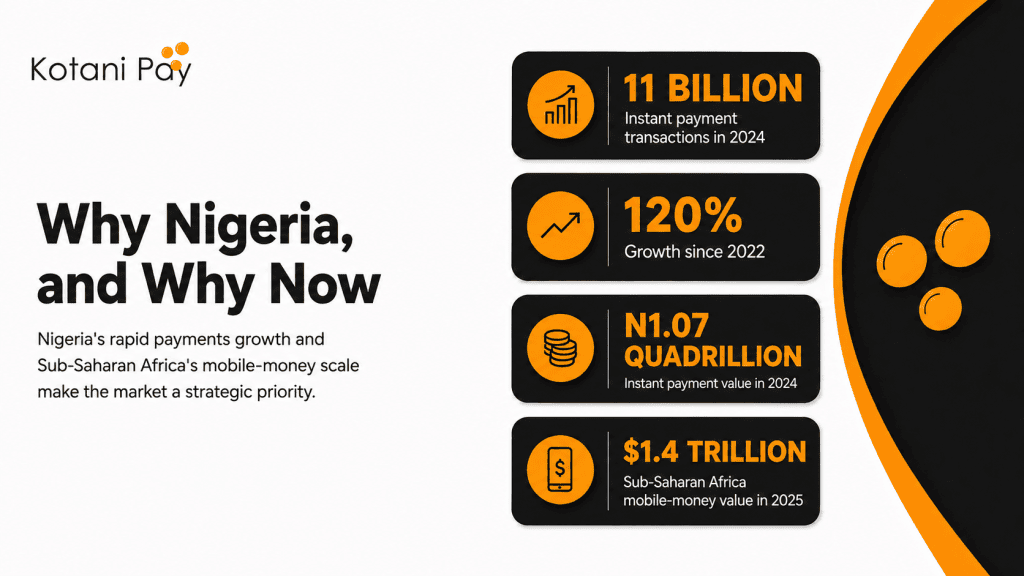
That scale sits inside a broader continental story. According to GSMA’s State of the Industry Report on Mobile Money 2026, mobile money crossed $2 trillion in global transaction value in 2025, doubling in just four years, with Sub-Saharan Africa alone accounting for $1.4 trillion of it, or roughly two-thirds of the global total.
Nigeria is a major contributor to that figure, and the region’s share of global mobile money volume has held steady at around two-thirds for the past five years, making it the anchor of the mobile-money economy rather than a peripheral market.
The friction businesses actually face:
- Sub-Saharan Africa remains the world’s most expensive region to move money through, with the World Bank’s Q3 2025 Remittance Prices Worldwide report putting the average cost of sending funds into the region at 8.46%, against a 6.36% global average, and nine of the thirteen highest-cost corridors worldwide originate from the region.
- Traditional bank-channel transfers average close to 15% globally, the most expensive channel tracked.
- More than 70% of Sub-Saharan African remittance corridors carry costs above 10%, versus 59% for the rest of the world.
Every added country integration is another set of banking relationships, compliance reviews, and settlement processes layered on top of that cost. This is the exact overhead Kotani Pay’s single API is built to remove.
One Integration, Complete Access to Nigeria
Rather than stitching together multiple local providers, businesses connect once through Kotani Pay’s API to:
- Collect payments directly into Nigerian bank accounts.
- Send payouts to local bank accounts.
- Settle cross-border transactions instantly using stablecoins, including USDT and USDC.
- Monitor collections, payouts, and settlements in real time through a centralized merchant dashboard.
- Launch no-code payment links to simplify customer onboarding.
“Nigeria is one of Africa’s most important commercial hubs and a priority market for businesses expanding across the continent. This expansion provides our partners with instant entry into this vital market through one simplified integration,” said Felix Macharia, CEO of Kotani Pay. “Scaling shouldn’t require reinventing your payment stack at every border. We are building the foundational infrastructure that allows businesses to expand across Africa with ease.”
Stablecoins Are Doing More of the Heavy Lifting
The stablecoin settlement rail Kotani Pay offers alongside local bank transfers isn’t incidental, it reflects where usage is already heading on the continent. Africa now leads the world in stablecoin ownership among crypto-active users, at 79%, according to BVNK’s Stablecoin Utility Report 2026, well ahead of the roughly 60% average across other emerging markets. Nigeria and South Africa are the two markets driving that adoption.
Nigeria’s own stablecoin footprint is outsized relative to its neighbors: the country accounts for roughly 60% of Sub-Saharan Africa’s stablecoin inflows since 2019, and ranked second globally on Chainalysis’s 2024 Global Crypto Adoption Index (sixth in 2025), with about $59 billion in crypto-asset inflows between mid-2023 and mid-2024, per IMF analysis. Stablecoins are increasingly the practical workaround for businesses facing currency volatility and slow correspondent-banking chains, settlement that takes seconds on-chain versus the 3–5 business days typical of correspondent banking.
One API, Multiple African Markets
Nigeria adds to Kotani Pay’s growing West African footprint, alongside Ghana, Senegal, Benin, Burkina Faso, Côte d’Ivoire, and Sierra Leone, deepening a presence that already spans East, Central, Southern, and West Africa. Through the same integration, businesses can reach:
- Local bank transfers across Nigeria, Kenya, South Africa, and other supported markets.
- Leading mobile money networks, including M-Pesa, MTN MoMo, Airtel Money, and other regional channels.
- Visa and Mastercard processing through MID-based card acquiring.
- Instant stablecoin settlement using USDT for faster treasury management and cross-border liquidity.
- A centralized dashboard providing real-time visibility into collections, payouts, settlements, and transaction performance across every connected market.
For a business entering Nigeria today, that means avoiding the standard pattern of negotiating separate rails for bank transfers, mobile money, and card acquiring in every new country, instead plugging into infrastructure that already spans the currencies and channels its customers actually use.
Building Africa’s Connected Payments Infrastructure
With every new market added, Kotani Pay moves closer to its vision of a unified African payments infrastructure one where the continent’s scale (nearly $1.4 trillion in mobile money volume, close to $2 trillion in Nigerian electronic payments value, and a fast-growing stablecoin settlement layer) is accessible through a single connection rather than a country-by-country buildout.