

Introduction
What fintech founders, VASPs, and compliance teams need to know about the 2025 capital divergence, the regulation landing across the continent, and the trust layer that global growth capital now demands
African founders closed 28 blockchain rounds in 2025. The number of deals barely moved. What changed was the size of the checks.
Total blockchain funding on the continent fell 26.6%, landing at US$90.1 million, even as the global blockchain market grew funding 28.8% to US$15.4 billion. Deal flow held. Capital pooled elsewhere.
Africa closed a record 2.81% of the world’s blockchain deals in 2025, and captured just 0.58% of the money. Read those two numbers side by side and the story becomes obvious: seed-stage activity is healthy, but the mid- and growth-stage checks that used to follow it have migrated to markets that feel easier to underwrite.
This is what this report is about, and why the compliance layer is no longer a back-office function for African blockchain companies. It’s the thing the biggest checks are now underwriting first.
Why the deal count held while the money left
A 2.81% share of global deal volume against a 0.58% share of global capital is not a rounding error. It’s a signal that early-stage conviction in African blockchain remains intact, founders are still building, and seed investors are still writing checks, but something is breaking down between seed and growth.
Global growth capital went risk-off in 2025. Risk-off capital doesn’t disappear; it re-routes to wherever onboarding, transaction monitoring, and multi-jurisdiction compliance reporting are automated, documented, and auditable on demand. Markets that can show a growth-stage investor a clean compliance trail, one system of record across onboarding, monitoring, and reporting, are the markets absorbing the checks that used to come to Africa.
A market building real utility — with a compliance surface to match
The 2025 data doesn’t describe a speculative market. It describes builders:
- 100% of tracked deployments sit at the application layer — real products solving real problems, not infrastructure experiments.
- Centralized Blockchain Services account for 67.9% of activity, the layer where custody, exchange, and on/off-ramp functions live, and where regulators and correspondent banks look hardest.
- 57.2% of models are pan-African, built to operate across borders from day one rather than scale market-by-market.
The regulatory map moved faster than most platforms did
Regulation across the continent didn’t creep in 2025 — it landed:
- 15 African jurisdictions now sit in the full “Legal” category for digital assets, up from 7 in 2024 — more than double in a single year.
- Kenya and Ghana passed Virtual Asset Service Provider (VASP) laws in late 2025, formalizing licensing regimes where none existed before.
- Nigeria and South Africa came off the FATF greylist the same year, removing a standing red flag for correspondent banks and international investors.
Fraud is scaling with the opportunity
The same rails that make African blockchain commerce fast and cheap are the rails fraud is scaling on:
- Deepfake incidents jumped sevenfold across markets in a two-quarter span.
- Stablecoins — the rails carrying most African cross-border commerce — now account for 84% of all illicit virtual asset volume globally.
That second figure deserves to sit on its own. Stablecoins are the backbone of African cross-border payments precisely because they’re fast, low-cost, and liquid, the same properties that make them attractive to launderers moving money across borders quickly. A platform can’t opt out of stablecoin rails without opting out of the market. It can only get serious about what moves across them.
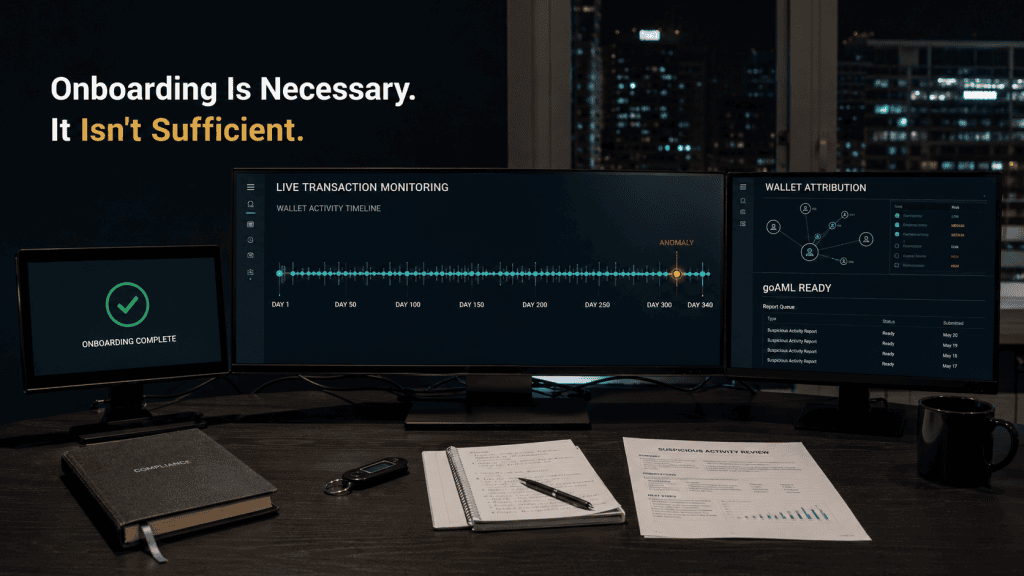
Onboarding is necessary. It isn’t sufficient.
Catching a fraudulent identity at signup is table stakes. It says nothing about what that wallet does on day 47, or day 340, once it’s inside the system.
With 84% of illicit virtual asset volume moving through stablecoins, the real exposure for a crypto platform lives in ongoing transaction behavior, not just the moment of account creation. In practice, that means:
- Live transaction monitoring that flags anomalous patterns as they happen, not in a monthly batch review.
- Wallet attribution that traces counterparties and exposure across chains, so a platform knows who it’s really transacting with.
- goAML-ready reporting that produces suspicious activity reports in the format regulators and financial intelligence units actually require — not a PDF that needs to be re-keyed by hand before it can be filed.
Onboarding stops the fraudster who’s easy to see. Monitoring is what catches the one who isn’t, and it’s what a regulator, a bank, or a growth-stage investor will actually ask to see evidence of.
What institutional-grade trust looks like to risk-off capital
Across South Africa, Nigeria, and Kenya, the three markets doing the most volume, the platforms attracting growth-stage capital in this environment share a pattern: their compliance stack reads as infrastructure, not paperwork. Onboarding, monitoring, and reporting operate as one connected system with a clean audit trail, rather than three separate tools stitched together under deadline pressure.
There’s also a quieter advantage inside all of this: reusable KYC. When a verified identity can be securely reused across services and jurisdictions instead of re-verified from scratch every time, it does two things at once. It removes friction for legitimate customers moving between products, which shows up directly in conversion. And it gives an investor doing diligence a single, portable proof of who’s been verified and how, which shows up directly in how fast that diligence closes.
Who this is for
This report is built for compliance officers, AML and fraud teams, legal and regulatory leads, founders, and growth-stage investors working in or entering African fintech and crypto in 2026, whether operating in a single market, across the continent, or from offshore.
Drawing on the CV VC African Blockchain Report 2025 and Sumsub’s experience running verification and monitoring for more than 4,000 companies across markets.