

Introduction
Western Union just did something remittance giants rarely do: it built on-chain rails into its core product instead of watching from the sidelines. On August 4, 2026, the company launched StableCard, a joint venture with stablecoin infrastructure provider Rain, combining a USDPT wallet with a Visa-branded card. Users can receive Western Union transfers straight into a stablecoin balance, hold that value in USDPT (issued by Anchorage Digital Bank on Solana and redeemable for dollars), and spend it anywhere Visa is accepted, including through Apple Pay and Google Pay.
The rollout starts in 37 markets, with Western Union targeting more than 60 by year-end. That’s a fast, deliberate expansion for a 175-year-old money-transfer company, and it follows the May 2026 launch of USDPT itself, built under the framework created by the U.S. GENIUS Act.
The interesting part isn’t the press release. It’s what the data says about why Western Union is moving now, and why Africa is likely to be one of the corridors that matters most.
The remittance math StableCard is trying to fix
Traditional remittance corridors into Sub-Saharan Africa remain the most expensive in the world. The World Bank pegs the region’s average cost at roughly 7.9% to send $200, nearly double the UN’s Sustainable Development Goal target of 3%. Correspondent banking settlement typically takes three to five business days, and all-in costs (wire fees, FX markups, intermediary deductions) can run as high as 2–7% even outside Africa-specific corridors.
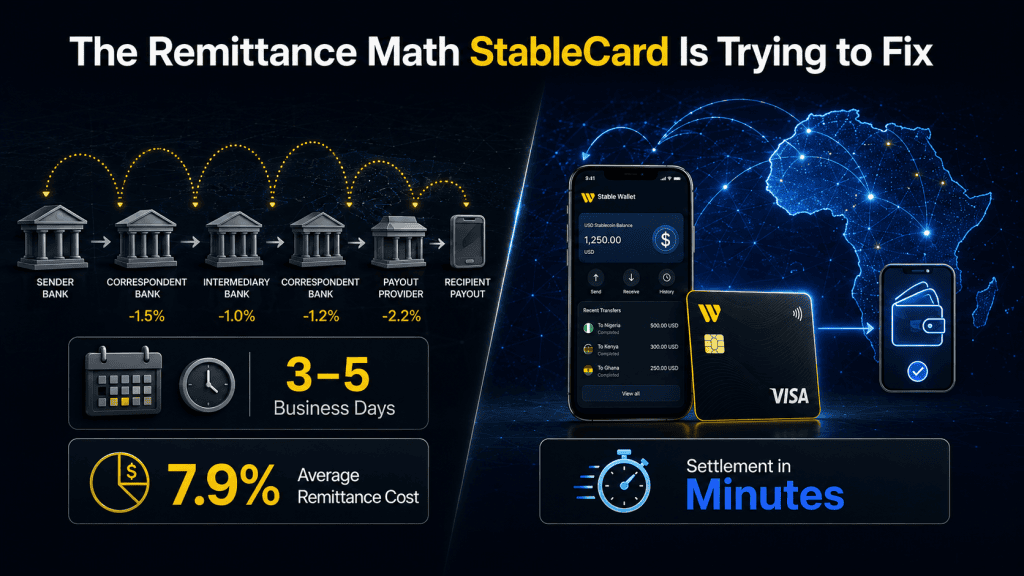
Stablecoin rails cut both dimensions at once. Industry estimates put stablecoin-based cross-border settlement at 2–4% total cost, with finality in minutes rather than days, because the transaction bypasses the correspondent banking chain entirely.
Multiply that by scale: Sub-Saharan Africa received about $54 billion in remittances in 2023, according to World Bank data, with Nigeria alone accounting for close to $19.5 billion of that. Even a few percentage points of fee compression across that volume represents real money staying in the hands of recipients rather than intermediaries, which is precisely the value proposition Western Union is now trying to capture with its own product rather than cede to fintech challengers.
Africa isn’t a side market for stablecoins — it’s the leading one
This is the part often missed in coverage of Western Union’s move: Africa isn’t a peripheral test market for stablecoin products, it’s the most stablecoin-native region in the world by usage intensity.
- According to BVNK’s Stablecoin Utility Report 2026, 79% of crypto-active users in Africa already hold stablecoins, the highest ownership rate globally, ahead of other emerging markets (~60%) and high-income economies (~45%).
- Chainalysis data shows Sub-Saharan Africa received roughly $205 billion in on-chain value between July 2024 and June 2025, up 52% year-over-year, with stablecoins increasingly used for payments, remittances, and inflation hedging.
- Stablecoins now make up an estimated 43% of all crypto transaction volume in Sub-Saharan Africa, and around 40% of Nigeria’s crypto market specifically, per Chainalysis and Yellow Card figures cited by the Milken Institute.
- Nigeria and South Africa are the clear regional leaders, using stablecoins for everything from remittances to corporate treasury management amid persistent local banking friction.
The regulatory backdrop matters more than it looks
StableCard only exists in its current form because of the GENIUS Act, the first comprehensive U.S. federal framework for payment stablecoins, signed into law in July 2025. It requires issuers to back tokens, with cash or short-term Treasuries, disclose reserves monthly, and grants stablecoin holders legal protections in an issuer insolvency. USDPT’s structure, issued by a chartered bank, redeemable at par, is a direct product of that framework.
That regulatory clarity is doing real work in unlocking institutional capital: the global stablecoin market has grown past $300 billion in 2026, and mainstream payment companies, custodial banks, and corporate treasuries that avoided unregulated stablecoins are now building on compliant ones. It’s also the same dynamic African regulators are wrestling with. Kenya, Ghana, Uganda, South Africa, and Mauritius are each at different stages of building virtual asset oversight frameworks, and the clearer those frameworks become, the more room there is for African-headquartered infrastructure, not just U.S. issuers riding into the continent through a Visa card, to capture this demand.
Why this matters beyond one company’s press release
Western Union’s move is a signal that traditional remittance and payments infrastructure now sees stablecoins as core product, not experimental sideline. Visa itself has been expanding stablecoin settlement across the CEMEA region (Central/Eastern Europe, Middle East, Africa) since mid-2025, and Flutterwave’s partnership with Polygon Labs, described by its CEO as the largest stablecoin deployment on the continent, is targeting a retail rollout through its Send App this year.
The pattern across all of these moves is the same: global payment rails are being rebuilt around dollar-denominated, blockchain-settled value, and Africa is the corridor where that shift is most visible in the underlying usage data, not just the press releases. For African fintechs, corporates, and infrastructure builders, the question StableCard raises isn’t whether stablecoins will matter to cross-border payments here, the 79% adoption number already answered that. It’s who builds, regulates, and captures the value of the rails that carry it: global incumbents importing a U.S.-issued token, or a homegrown ecosystem built for the corridors that need it most.