
Introduction
Ghana has published the full list of 11 companies admitted into the Securities and Exchange Commission’s Virtual Asset Regulatory Sandbox, marking an important step in the implementation of the country’s new digital asset regulatory framework.
The programme commenced in March 2026 under the Virtual Asset Service Providers Act, 2025 (Act 1154). It will allow the SEC to supervise selected virtual asset services in a controlled environment and collect operational data before finalising Ghana’s activity-specific licensing and registration requirements.
The 11 sandbox participants are:
- Africoin
- Blu Penguin
- GoldBod
- HanyPay Ghana
- Hyro Exchange GH Ltd
- HSB Global
- KoinKoin
- WhiteBIT
- Vaulta
- XChain
- Bsystem Ltd
What the companies will test
The sandbox participants will test a range of virtual asset services. Africoin will pilot gold tokenisation, while Blu Penguin will explore the tokenisation of a payment system. GoldBod will provide custody services for gold-backed securities, and HanyPay Ghana will test virtual asset exchange and digital payment services. Hyro Exchange GH Ltd, HSB Global, KoinKoin and WhiteBIT will pilot virtual asset exchange services, while Vaulta, XChain and Bsystem Ltd will explore the fractional tokenisation of global assets.
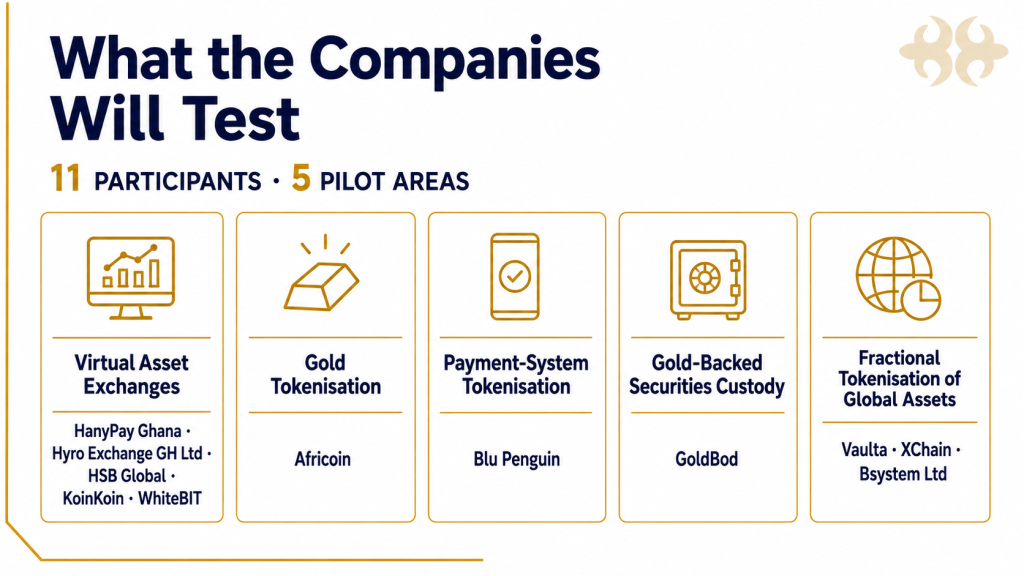
Five participants, HanyPay, Hyro Exchange, HSB Global, KoinKoin and WhiteBIT, will test virtual asset exchange services. Africoin will pilot gold tokenisation, while Blu Penguin will test the tokenisation of a payment system.
Vaulta, XChain and Bsystem will explore fractional ownership of global assets. GoldBod will participate as a custodian for gold-backed securities, connecting the regulatory pilot with Ghana’s strategically important gold industry.
A controlled route towards licensing
The sandbox is expected to run for 12 months. After the first six months, the SEC may begin transitioning participants that demonstrate market readiness and meet regulatory requirements towards full activity-specific licensing. Those requiring further development could continue testing for the remainder of the programme.
During the pilot, the regulator will be able to assess:
- Customer asset custody and segregation.
- Transaction settlement and reporting.
- Cybersecurity and operational resilience.
- Anti-money laundering and counter-terrorist-financing controls.
- Consumer protection and risk disclosures.
- Governance, liquidity and market integrity.
- The verification and auditing of tokenised assets.
Admission into the sandbox is not equivalent to receiving a permanent operating licence. Each participant is authorised to test a particular service under defined regulatory conditions.
Ghana is regulating an already active market
Ghana’s regulatory framework is responding to digital asset activity that has already reached considerable scale.
The Bank of Ghana estimates that the country’s virtual asset ecosystem includes more than three million users. This represents approximately 17% of Ghana’s adult population.
Industry estimates also indicate that Ghana received approximately $3 billion in cryptocurrency transaction value between July 2023 and June 2024. Although these figures are on-chain estimates rather than audited national payment statistics, they demonstrate the size of the market that developed before the introduction of formal licensing.
Digital asset services are also emerging alongside one of Africa’s most developed mobile money markets. By the end of 2025, Ghana reportedly had:
- 80.5 million registered mobile money accounts.
- 26.7 million active mobile money accounts.
- GH₵4.54 trillion in annual mobile money transaction value.
This extensive payment infrastructure creates opportunities for virtual assets to support digital commerce and cross-border transactions. However, it also increases the need for clear rules governing custody, consumer protection, financial crime and interactions between crypto platforms and regulated payment providers.
Why GoldBod’s participation matters
GoldBod’s role in the sandbox is particularly noteworthy because Ghana is one of Africa’s leading gold producers.
According to Reuters, Ghana exported 55.7 metric tonnes of gold worth approximately $5 billion during the first five months of 2025. The Bank of Ghana’s gold holdings also increased from 8.77 metric tonnes in 2022 to approximately 30.8 tonnes by February 2025.
Testing the custody of gold-backed securities could help Ghana assess whether tokenisation can improve investment access, ownership records and asset traceability.
However, regulated gold-backed products will require strong safeguards. Regulators will need to establish how the underlying gold is held, independently verified and audited, as well as whether token holders have clear redemption and ownership rights.
Part of a $205 billion regional market
Ghana’s move comes amid rapid growth in virtual asset activity across Africa.
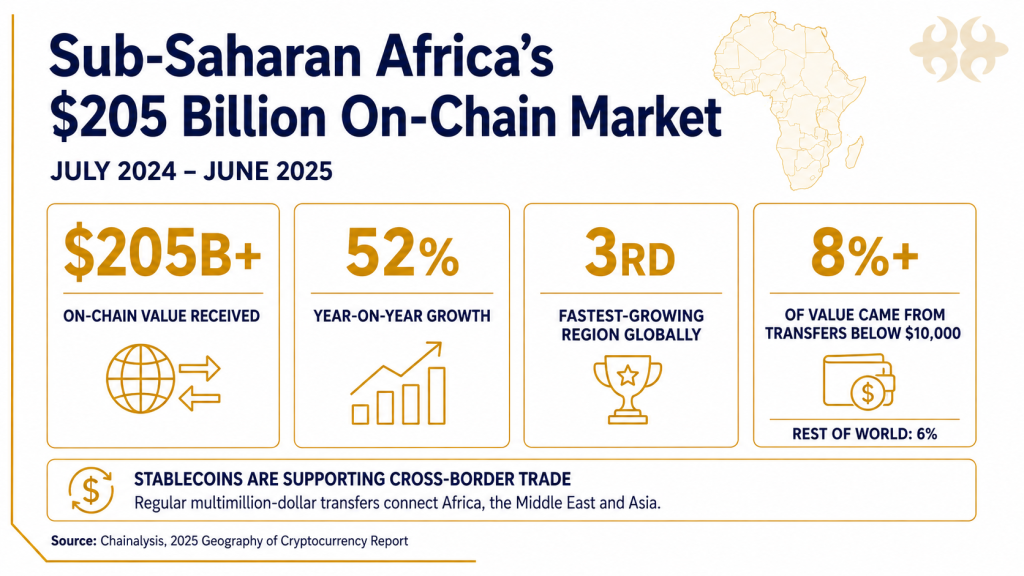
According to Chainalysis, Sub-Saharan Africa received more than $205 billion in on-chain value between July 2024 and June 2025. This represented approximately 52% year-on-year growth and made the region the third-fastest-growing cryptocurrency market globally.
Retail activity remains particularly important. Transfers below $10,000 accounted for more than 8% of the region’s total transaction value, compared with approximately 6% across the rest of the world.
Chainalysis also identified regular multimillion-dollar stablecoin transfers linked to merchant payments and trade between Africa, the Middle East and Asia. These use cases show that virtual assets are increasingly being used for cross-border settlement alongside retail trading.
What happens next?
The findings from the 11 pilots will help the SEC determine how exchanges, tokenisation platforms, custodians and other virtual asset businesses should be regulated.
The market will be watching for Ghana’s final rules on:
- Minimum capital requirements.
- Customer asset segregation.
- Custody and reserve standards.
- Stablecoin issuance and redemption.
- Governance and local presence.
- Foreign virtual asset service providers.
- Cybersecurity and regulatory reporting.
- Tokenised gold and other real-world assets.
The sandbox is therefore more than a trial for 11 companies. It is a regulatory laboratory through which Ghana will determine how its virtual asset industry is licensed, supervised and integrated into the wider financial system.
If the programme delivers transparent rules and a clear path from testing to licensing, Ghana could emerge as one of West Africa’s most structured markets for virtual assets and tokenised financial products.