
Introduction
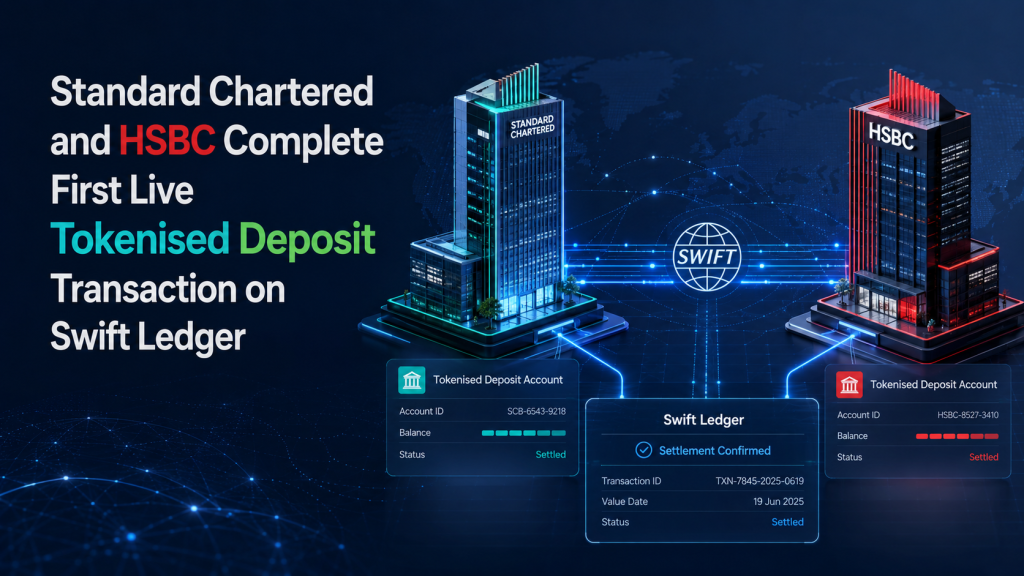
Standard Chartered and HSBC have completed the first live cross-border transaction using tokenised bank deposits on Swift’s blockchain-based ledger, marking a significant step towards always-on payments between regulated financial institutions.
The transaction, announced on 19 August 2026, demonstrated that deposits issued on two separate banking platforms could interact through shared infrastructure while maintaining existing regulatory controls and settlement systems.
It moves tokenised deposits beyond isolated bank platforms and closer to an interoperable model for global payments.
How the transaction worked
HSBC and Standard Chartered exchanged payment messages through Swift’s ledger. The resulting obligations were recorded on HSBC’s Tokenised Deposit Service and Standard Chartered’s tokenised-deposit infrastructure.
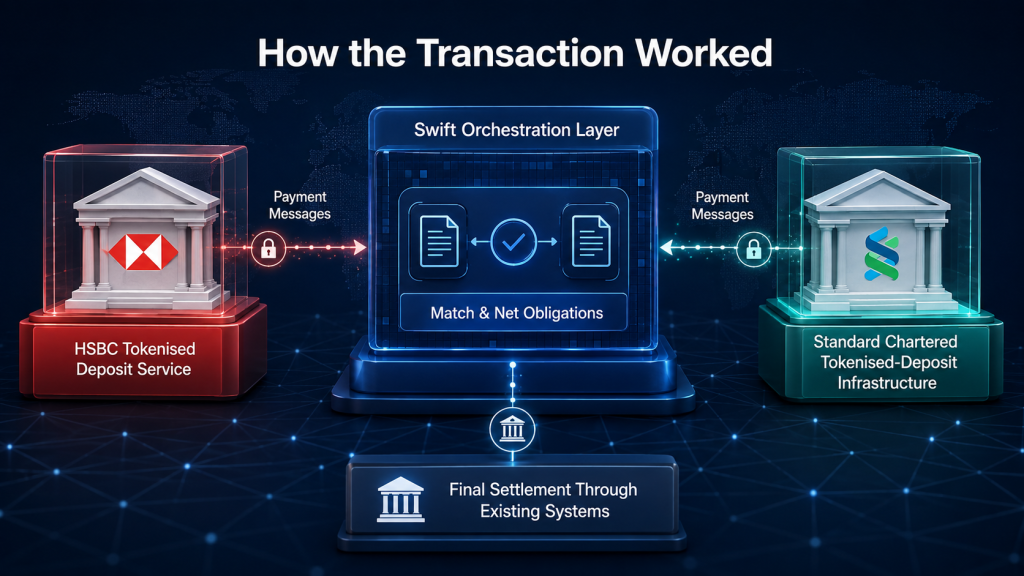
Swift’s blockchain-based ledger acted as the orchestration layer. It matched and netted the obligations between the banks before final settlement took place through existing payment systems.
This distinction is important. The transaction did not replace the banking system or move the entire settlement process onto a public blockchain. Instead, it connected two regulated deposit platforms through common digital infrastructure.
The banks did not disclose the transaction’s value, currencies or payment corridor. However, the successful execution established that independently issued tokenised deposits could be coordinated across institutions. Standard Chartered
The numbers behind the milestone
The transaction followed Swift’s July 2026 announcement that its blockchain-based ledger was ready for initial use.
Key figures include:
- 17 banks across six continents preparing to pilot live tokenised-deposit transactions.
- Swift moved the ledger from concept to initial activation in approximately nine months.
- More than 30 banks from 16 countries had previously participated in shaping its functionality and governance.
- HSBC’s Tokenised Deposit Service is already live in six markets: Hong Kong, Singapore, Luxembourg, the United Kingdom, the United States and the United Arab Emirates.
- HSBC’s service supports seven currencies: CNH, HKD, SGD, EUR, GBP, USD and AED.
- Standard Chartered operates across 55 markets, giving it an extensive network through which regulated digital-money services could eventually be deployed.
According to Swift, the participating institutions are exploring tokenised deposits to provide 24/7 payment availability and improve liquidity efficiency. Swift
Why cross-border payments need new infrastructure
Global cross-border payments are estimated at approximately $200 trillion annually, while daily foreign-exchange turnover reached about $9.6 trillion in April 2025. The size of these markets means that even modest improvements in settlement speed, liquidity management and reconciliation could have significant commercial value. Financial Stability Board, Bank for International Settlements
Yet the international payment system still faces material friction.
The Financial Stability Board reported that only 50.6% of wholesale cross-border payments made through Swift were credited within one hour in 2024, while 92% were completed within one business day. The G20 target is for 75% of wholesale cross-border payments to be credited within one hour by the end of 2027. Financial Stability Board
Tokenised deposits could help by enabling banks to synchronise payment obligations, confirm the availability of funds and manage liquidity outside conventional operating hours.
The Bank for International Settlements has argued that tokenisation could replace the sequential updating of accounts across chains of correspondent banks with a more integrated process. This could reduce reconciliation requirements and improve the coordination of cross-border transactions. Bank for International Settlements
Tokenised deposits are not stablecoins
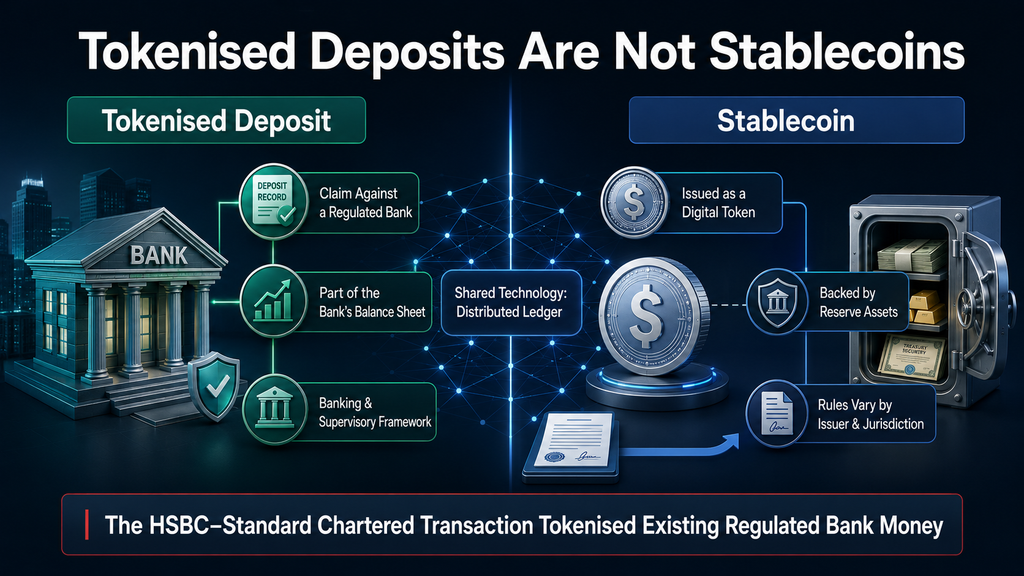
Although both instruments use distributed-ledger technology, tokenised deposits and stablecoins have different structures.
A tokenised deposit represents a customer’s claim against a regulated commercial bank. It remains part of the bank’s balance sheet and operates within established banking, compliance and supervisory frameworks.
Stablecoins are generally privately issued digital tokens backed by reserves held outside the traditional deposit framework. Their regulatory treatment, redemption structures and risk profiles vary by issuer and jurisdiction.
The HSBC–Standard Chartered transaction therefore represents the tokenisation of existing regulated bank money, rather than the creation of a separate digital currency.
What this means for corporate treasury
For corporate and institutional clients, the potential benefits extend beyond faster payments.
Interoperable tokenised deposits could enable businesses to move liquidity across banks and jurisdictions continuously, improve cash visibility, reduce reconciliation complexity and manage working capital closer to real time.
They could also reduce the need to maintain excess liquidity across multiple accounts to accommodate different banking hours, currencies and settlement windows.
However, widespread adoption will depend on more than technical capability. Banks and regulators will still need to address legal finality, operating-hour mismatches, foreign-exchange settlement, data standards, cybersecurity and interoperability with domestic payment systems.
A significant step, but not yet industry-wide scale
The transaction demonstrates that regulated tokenised deposits can operate across separate bank platforms using shared infrastructure. It does not yet prove that the model can process high transaction volumes across multiple currencies, jurisdictions and regulatory regimes.
That will be the next test.
With 17 banks preparing for live pilots, Swift is positioning its ledger as a bridge between emerging tokenised financial infrastructure and the existing correspondent-banking network.
For Standard Chartered and HSBC, the transaction represents an early but important shift: tokenised deposits are moving from individual bank products towards interoperable instruments capable of supporting global liquidity movement.
If the next pilots demonstrate scale, resilience and commercial value, this milestone could become an important foundation for 24/7 regulated cross-border payments.