
Introduction
Tether has completed its first full independent financial statement audit, marking a significant step forward for both the company and the wider stablecoin industry.
KPMG U.S. issued an unqualified audit opinion on Tether International’s financial statements for the year ended 31 December 2025. This is the most favourable opinion an independent auditor can provide, indicating that Tether’s financial position, operating results and cash flows were fairly presented in all material respects under U.S. Generally Accepted Accounting Principles.
The audit went substantially further than Tether’s regular quarterly reserve attestations. KPMG examined the company’s complete financial statements, including its balance sheet, income statement, cash flows and changes in equity. It also tested transactions, systems, ownership records, asset valuations, counterparties and supporting documentation.
In an unusually detailed verification process, KPMG physically inspected and counted every individual gold bar held by Tether, confirming the existence and identifying information of each bar rather than relying exclusively on custodian reports.
The numbers behind the audit
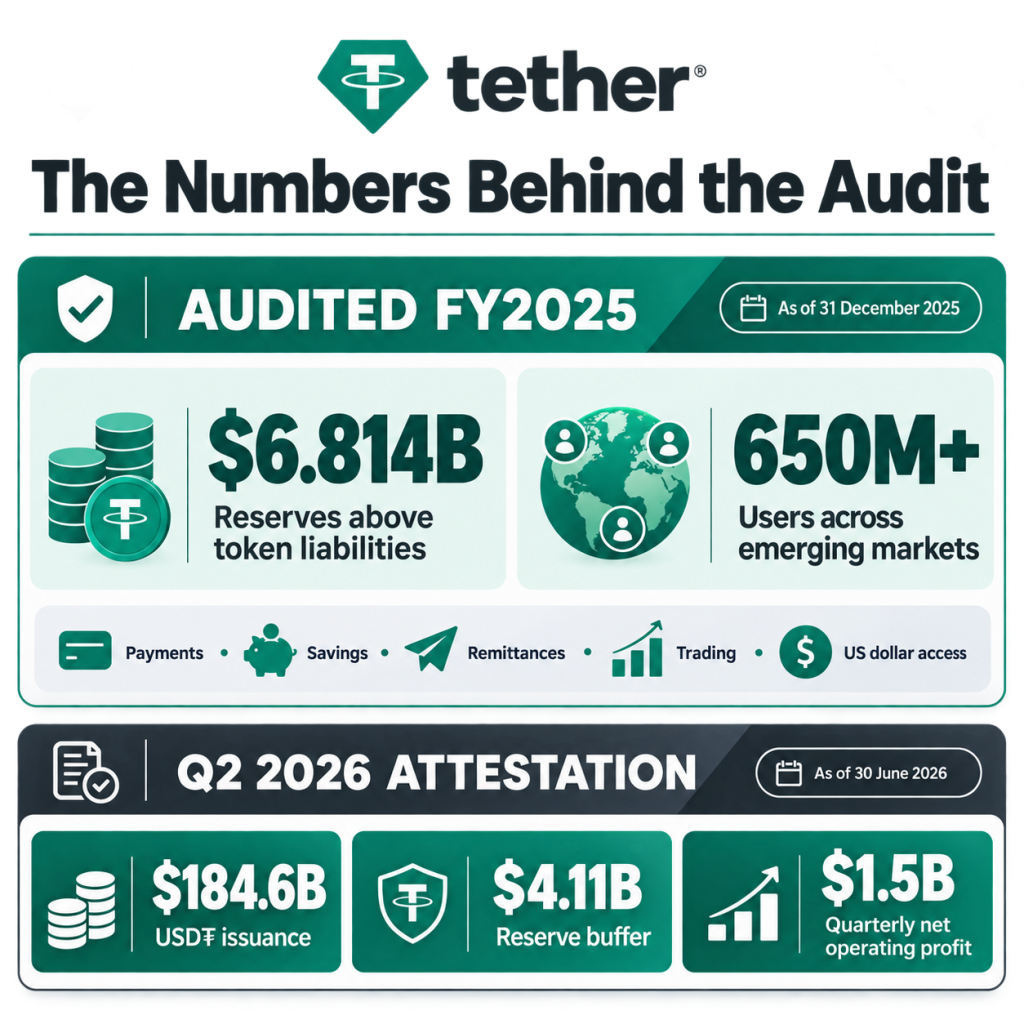
Tether’s audited 2025 financial statements showed that:
- Reserves exceeded token liabilities by $6.814 billion.
- More than 650 million users across emerging markets rely on Tether’s products, according to the company.
- USD₮ continues to support payments, savings, remittances, trading and access to U.S. dollars globally.
The audit examined Tether’s financial position as of 31 December 2025. It should therefore be distinguished from the company’s more recent quarterly figures.
According to Tether’s separate Q2 2026 attestation, USD₮ issuance had reached approximately $184.6 billion by 30 June 2026, while the company reported a $4.11 billion reserve buffer and $1.5 billion in quarterly net operating profit.
Why this matters
Tether has published independent reserve attestations for years, but an attestation is narrower than a complete financial statement audit. The KPMG engagement subjected the company’s broader financial operations, controls, records and reporting to independent examination.
That distinction is important as stablecoins become increasingly embedded in global financial infrastructure. Banks, payment companies, regulators and institutional investors require stronger evidence that issuers can account for their reserves, liabilities and operating activities.
For the wider market, the audit raises expectations around transparency and governance. Stablecoin issuers may face growing pressure to move beyond periodic reserve snapshots towards comprehensive audits of their complete financial statements.
For Tether, the clean opinion addresses one of the most persistent questions surrounding the world’s largest stablecoin issuer: whether its financial operations and reserves could withstand a full Big Four audit.
The outcome does not eliminate the need for continued scrutiny. However, it represents Tether’s strongest independent financial validation to date and establishes an important benchmark for accountability as stablecoins move further into mainstream payments, savings and cross-border finance.