

Introduction
Africa’s crypto holders no longer have to choose between holding their assets and having cash in hand — and the numbers show why that matters.
On 25 August 2026, VALR — Africa’s largest crypto exchange by user base, launched Borrow, a product that lets users draw a loan against their Bitcoin, Ethereum, and other crypto holdings without selling them. It’s a small feature announcement on the surface, but it lands at a moment when the data points to crypto-backed lending becoming one of the more consequential product categories in African fintech.
What VALR Launched
Borrow lets both retail and corporate VALR users post crypto as collateral and draw down a loan instantly credited to their account, usable for trading, converting to fiat, withdrawing, or spending via VALR Pay. There are no credit checks and no paperwork; loan limits are set automatically based on the collateral asset’s value and risk profile, and there’s no fixed repayment schedule, so users can repay at their own pace or top up collateral as prices move.
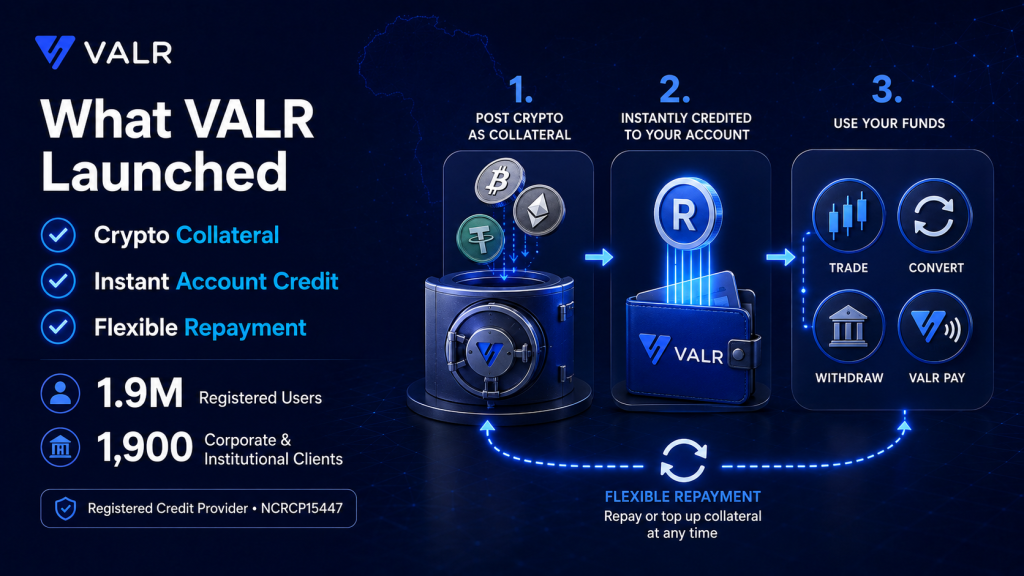
The product is run through VALR Loans (Pty) Ltd, a separately registered credit provider under South Africa’s National Credit Regulator (NCR registration NCRCP15447), a detail that matters more than it might seem, given how much of the appeal of these products for regulators hinges on whether crypto lenders operate inside or outside conventional consumer-credit oversight.
Borrow extends a product suite that already includes spot and margin trading, perpetual futures, staking, lending, OTC services, and VALR Pay. VALR says it now serves 1.9 million registered users and 1,900 corporate and institutional clients, and counts Pantera Capital, Coinbase Ventures, and Fidelity’s F-Prime Capital among its backers.
The Data Behind the Timing
VALR isn’t moving into lending on a whim, it’s following a trend that’s visible in the numbers at every level, from the global market down to the specific gap in African credit access.
Crypto-backed lending is one of the fastest-growing corners of digital finance. Estimates for the global crypto-backed lending market put it at roughly $7.8 billion in 2024, projected to grow at a 22.6% compound annual rate through 2033, reaching somewhere in the $60+ billion range by then, depending on the model used. A separate, broader measure of the outstanding value of crypto-collateralised loans (rather than platform revenue) put the figure at $73.6 billion by Q3 2025, a cycle high. Roughly 63% of that activity now runs through decentralised finance protocols, with the remaining 37% on centralised platforms like VALR.
Africa is the fastest-growing region for digital lending generally. Industry market-sizing research points to Africa posting the highest projected CAGR (around 22%) of any region in digital consumer lending through 2031, ahead of Asia-Pacific, which still leads on absolute market size. That’s the macro backdrop crypto-backed lending is stepping into.
South Africa’s crypto user base is now large enough to make a lending product viable at scale. By July 2025, the country’s three largest exchanges: Luno, VALR, and OVEX, had a combined 7.8 million registered users, holding an estimated R25.3 billion (roughly $1.5 billion) in custody as of December 2024, according to South African Reserve Bank data. That’s a meaningful base of “crypto-rich” users who, until products like Borrow existed, had only one real option for accessing liquidity: selling.
Africa’s crypto lenders are following a script that’s already playing out elsewhere on the continent. Nigerian exchange Busha launched a comparable crypto-backed loan product earlier in 2026, offering up to 50% loan-to-value against Bitcoin and Solana holdings, disbursed in naira, at a 2% monthly interest rate. Industry coverage of that launch framed it as part of a broader pattern: African crypto platforms borrowing a page from traditional finance, where lending is a genuine profit centre, rather than remaining single-product trading venues. The open question industry analysts are watching is whether these lenders deploy their own capital into loans, or simply intermediate liquidity sourced from global DeFi lending protocols.
Why This Matters Beyond VALR
A crypto-backed loan solves a specific, real problem: someone holding Bitcoin or Ethereum who needs cash today, but doesn’t want to trigger a taxable disposal or give up exposure to a price rally, has historically had no good option in African markets. Standard loan-to-value practice in the broader crypto lending industry sits between 50–75%, with Bitcoin-backed loans typically capped nearer 50% given the asset’s volatility, a discipline that protects both the borrower and the platform’s balance sheet.
For a continent where currency instability, thin traditional credit infrastructure, and a young, high-adoption crypto user base already coexist, a regulated, NCR-registered crypto lending product is a meaningfully different proposition than the same feature launching in a market with deep consumer credit access. It’s a sign that African crypto platforms are starting to compete not just on trading fees and asset listings, but on the same ground traditional banks have occupied for decades.
The Bottom Line
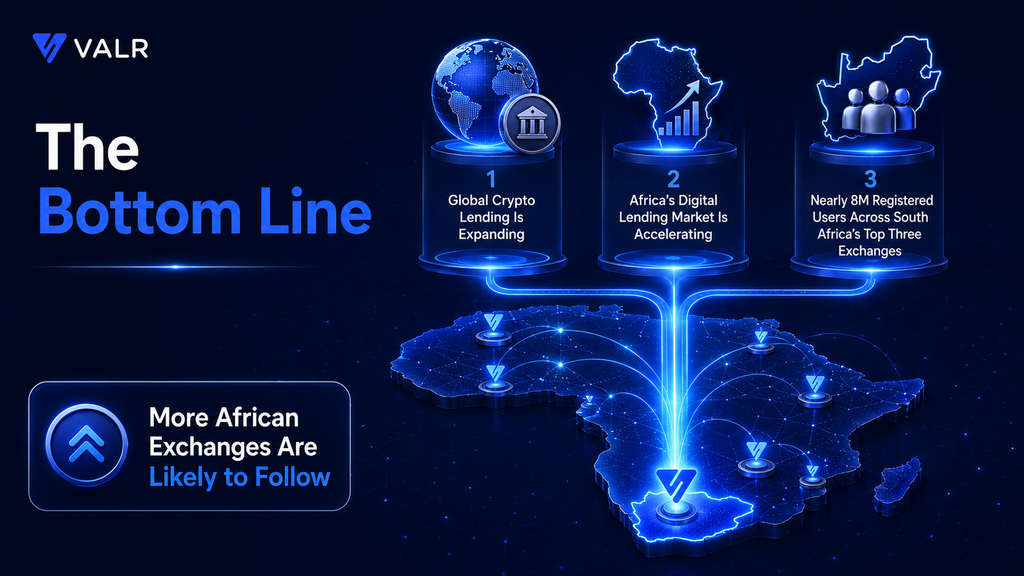
VALR’s Borrow launch is a single product update, but it sits at the intersection of three things the data all point toward: a fast-growing global crypto lending market, Africa’s outsized growth rate in digital lending specifically, and a South African crypto user base now large enough, nearly 8 million registered users across the top three exchanges, to make this kind of product commercially meaningful rather than experimental. Expect more African exchanges to follow the same path Busha and VALR have now both taken.