
Introduction
Kenya has quietly become East Africa’s most important Web3 proving ground, and a new report from Hashed Emergent, with knowledge partners Web3 Developer Clubs and the Virtual Assets Chamber of Commerce, lays out exactly why. For anyone building bridges between global capital, corporates, and Africa’s blockchain economy, this is essential reading. Here’s what stands out.
The funding story: finance is eating everything
Kenyan Web3 startups raised $14M in 2025, the ecosystem’s second-highest total since 2021, trailing only the $17M peak of 2022. Since 2021, over 45 startups have collectively raised more than $34M across finance, infrastructure, and emerging verticals.
The headline number is the finance sector’s 25x surge to $10M, driven almost entirely by stablecoin-powered use cases: payments, on/off-ramps, and neobanks. Infrastructure funding rebounded too, reaching $4M after two quiet years, as investors backed stablecoin rails and real-world-asset (RWA) tokenization plays.
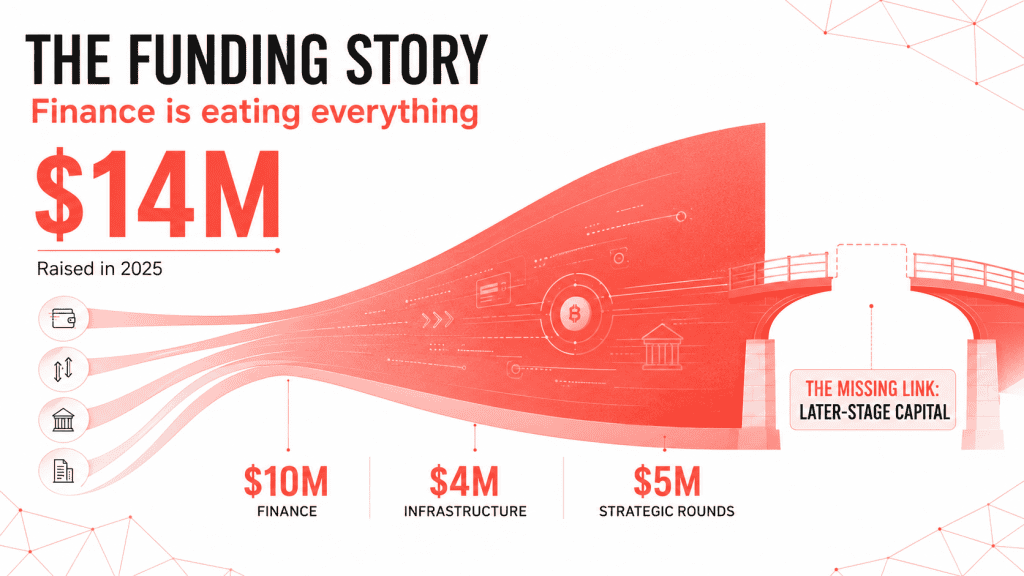
The catch: later-stage capital is still missing. Deal activity remains clustered at pre-seed and seed, with 2025 marking the first appearance of strategic rounds ($5M), a signal of deeper corporate and ecosystem engagement, but not yet proof of a mature growth-stage market. That funding gap is exactly the kind of structural challenge a hub connecting local builders to global capital could help close.
Why Kenya, why now
Three data points explain Kenya’s position as the anchor for Web3 in East Africa:
- In East Africa for blockchain adoption across several on-chain metrics
- In East Africa for on-chain value received in 2025
- In East Africa for developer activity
Kenya’s decades-long lead in mobile money has made it the natural testbed for stablecoin and on-chain payment infrastructure on the continent, the same instinct that built M-Pesa is now building B2B payment rails, neobanks, and on/off-ramps (Peer, Nuzo, Kotani Pay, Swypt, and dozens more).
The builders behind it
Kenya’s developer ecosystem is young (86% under 28), Nairobi-centric (82% of activity), and more experienced than the demographics suggest — 43% have 3–5 years building in Web3, and 41% self-identify as founders, not employees. It’s also more diverse than most Web3 communities globally, with 25% female participation.
Two numbers matter most for anyone thinking about talent or partnerships:
- 72% of developers are compensated in stablecoins — reinforcing stablecoins as the ecosystem’s core settlement layer, not just a product category.
- Employment is largely informal and freelance-driven — the talent pipeline is outpacing the formal job market, which is itself an opportunity for structured programs and employer connections.
Ethereum still anchors 70% of developer portfolios, but the stack is diversifying fast, with rising interest in Rust, and builder attention expanding from pure DeFi/payments into RWA tokenization and Web3 x AI.
Regulation: from caution to clarity
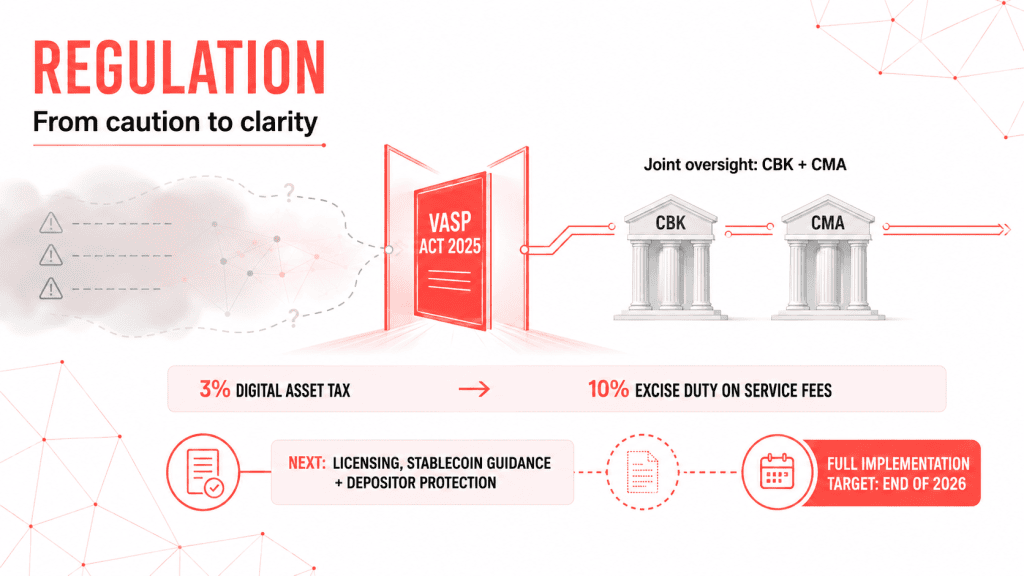
The single biggest shift in 2025 was legislative. The Virtual Asset Service Providers (VASP) Act 2025, assented to in October, is Kenya’s first comprehensive crypto law — placing licensing oversight jointly under the Central Bank of Kenya and the Capital Markets Authority. It replaces a decade of cautious warnings (dating to the CBK’s 2015 Bitcoin advisory) with a formal recognition of digital assets.
Alongside it, the tax regime matured: the punitive 3% Digital Asset Tax — a flat levy on gross transaction value that drove criticism and pushed some activity offshore — was repealed and replaced with a 10% excise duty on platform service fees only, aligning crypto tax treatment with banks and mobile money, and set below the 15% rate applied to traditional financial services.
Kenya isn’t fully there yet. Licensing categories, capital requirements, and fidelity bonds are still pending subsidiary regulations, meaning crypto companies currently operate in a technically-legal gray zone without formal depositor protections. Compared to neighbors, Kenya’s framework (2025) is newer than South Africa’s (2022, ~300 licenses approved) and Nigeria’s (2022/2024, 2 provisional licenses) — but the trajectory, spurred partly by Kenya’s 2024 FATF grey-listing, is toward full implementation by end of 2026: VASP licensing, stablecoin-specific guidance, and even an active CBDC study.
The bottom line
Kenya has the adoption numbers, the developer talent, and as of this year, the legal foundation to be Africa’s stablecoin and on-chain payments capital. What it doesn’t yet have is enough growth-stage capital, formal employment structures for its builders, or full regulatory clarity on the ground. That combination, strong fundamentals, real gaps, is precisely the moment where a serious connector between global corporates, capital, and Kenyan (and pan-African) blockchain builders can have outsized impact.