
Introduction
South Africa has taken a significant step toward formalising how crypto assets move across its borders. On 3 August 2026, the National Treasury and the South African Reserve Bank (SARB) jointly released a draft Crypto Assets Manual for cross-border activities, opening it up for public comment. For the first time, the country is spelling out exactly when moving crypto across borders becomes a regulated, reportable event.
For anyone building, investing in, or advising on blockchain and stablecoin activity in Africa, this is worth paying close attention to.
Why Now?
This draft Manual doesn’t stand alone. It follows a broader push to modernise South Africa’s capital flow rules:
- 17 April 2026: Draft Capital Flow Management Regulations were published for public comment.
- 15 May 2026: National Treasury and SARB issued a joint statement addressing public concerns around the treatment, possession, and trading of crypto assets — and flagged that a dedicated cross-border crypto framework was coming.
- 3 August 2026: That framework arrived, in the form of the draft Manual.

The goal is to close gaps that could let crypto assets act as a workaround for existing exchange controls, while giving the Financial Surveillance Department (FinSurv) better tools to detect and disrupt illicit financial flows.
The Core Mechanic: When Does a Transaction Become “Cross-Border”?
This is the part that matters most for anyone operating in this space. Under the draft rules, a crypto transaction is only treated as cross-border — and therefore reportable to FinSurv — when assets move:
- Between a domestic Authorised Crypto Asset Service Provider (CASP) and an offshore CASP, or
- From a domestic Authorised CASP to a non-custodial wallet
In other words, simply buying or selling crypto in rand through a local, licensed provider won’t trigger a report. It’s the act of sending value out of the regulated domestic system, offshore or into a private wallet, that flips the switch.
To operate legally in this channel, a provider needs to be an Authorised CASP, and the draft Manual lays out the practical mechanics: how to apply for and be adjudicated as an Authorised CASP, the permissions and conditions attached to cross-border crypto transactions, administrative responsibilities, and the reporting obligations owed to FinSurv.
Who Can Actually Move Crypto Offshore?
For now, the rules are narrow: only individuals will be permitted to externalise crypto assets through Authorised CASPs, and only within their existing single discretionary allowance or foreign capital allowance, the same limits that already govern how much money South Africans can move offshore in traditional currency. Businesses and institutions aren’t yet in scope for this particular pathway.
What the Rules Deliberately Don’t Do
A few notable boundaries:
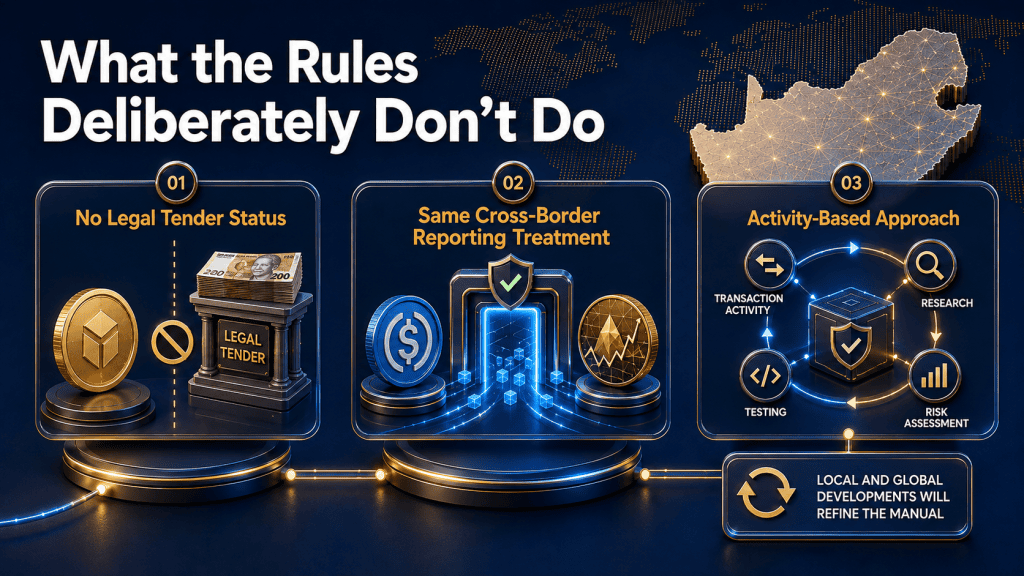
- The framework does not grant crypto assets legal tender status in South Africa.
- It does not, at this stage, distinguish between different types of crypto assets — a stablecoin and a more volatile token are currently treated the same way for cross-border reporting purposes.
- SARB has described this as an activity-based approach, arrived at after research, testing, and risk assessment, and has signalled that both local and global developments will keep shaping refinements to the Manual over time.
The Bigger Picture
According to blockchain analytics firm Chainalysis, South Africa already has hundreds of licensed virtual asset service providers, and reporting suggests major banks are in advanced stages of developing crypto products for institutional clients. That context matters: this isn’t regulation arriving in a vacuum, it’s catching up to an already-active market.
Practically, the shift means that sending crypto offshore will soon need to route through an authorised provider, with the transaction flagged to FinSurv.
Timeline for Comment
Interested parties, exchanges, CASPs, corporates, and individuals alike, have until 30 September 2026 to submit written comments on the draft Manual.
Why This Matters for Africa’ Blockchain Ecosystem
South Africa is one of the continent’s largest and most mature crypto markets, so how it chooses to regulate cross-border flows will likely influence conversations happening in other African jurisdictions currently weighing their own frameworks. For organisations working to connect global capital with African blockchain infrastructure, including stablecoin corridors, remittance rails, and institutional integrations, this draft Manual is an early signal of where compliance expectations are heading: authorised, licensed intermediaries; clear reporting triggers; and continued alignment with existing exchange control limits, at least for now.
The consultation period is the moment for industry voices to shape the final rules. Given the pace of change in this space, expect this Manual to evolve further before it’s finalised.