

Introduction
On 31 July 2026, the Nigeria Revenue Service (NRS) published Information Circular No. 2026/21, its first comprehensive guidance on how Virtual Assets (VAs), crypto, stablecoins, NFTs, tokenized securities, and more, will be taxed. For anyone building, trading, or transacting in this space in Nigeria, this is the framework to know.
Here’s the full picture, broken down.
Why This Matters
Nigeria has one of the largest crypto-user bases in the world, and until now, tax treatment of VAs sat in a gray zone.

This circular changes that, grounding VA taxation firmly in the Nigeria Tax Act 2025 (NTA) and the Nigeria Tax Administration Act 2025 (NTAA), and applying to anyone who acquires, disposes of, earns income in, or provides services around virtual assets, including exchanges (VASPs) and P2P marketplace operators.
Six Categories, Six Treatments
The NRS didn’t take a one-size-fits-all approach. VAs are split into six categories, each with distinct rules:
- Cryptocurrencies & exchange tokens (Bitcoin, Ether, Solana, BNB) — income tax on disposal gains, plus stamp duty on transfers.
- Stablecoins & payment tokens (USDT, USDC, DAI) — same tax types apply, but because gains are measured against the pegged fiat currency, taxable gains are usually nil or negligible. If a stablecoin pays yield, that yield is taxed separately as Category 4 income.
- Security & investment tokens — tokenized equity, bonds, and revenue-sharing tokens. Taxed like Category 1, though a narrow exemption exists for tokenized Nigerian stocks and shares specifically.
- Utility & governance tokens — includes staking rewards, DAO votes, and DeFi yield, all taxable as income upon receipt.
- NFTs — tax treatment hinges on whether you’re the creator, an investor, or a trader.
- eNaira & CBDCs — treated exactly like fiat currency. No VA tax obligations at al
Three Taxes Can All Apply to One Transaction
A single VA transaction can trigger income tax, VAT, and stamp duty simultaneously, since each targets a different taxable event:
- Income tax — on gains from disposal, mining and staking rewards, DeFi yield, salaries or professional fees paid in VA, and taxable airdrops.
- VAT (7.5%) — the transfer of a VA itself is not a taxable supply, but service fees around it are: exchange fees, brokerage commissions, custody, wallet management, and advisory services. Paying for goods or services with VA also triggers VAT on the underlying supply, just as if you’d paid in Naira.
- Stamp duty (1.5%) — applies specifically to TOKEN-to-FIAT and FIAT-to-TOKEN conversions. It’s withheld in token form by the VASP from the party receiving the tokens, and it doesn’t reduce the fiat side of the deal.
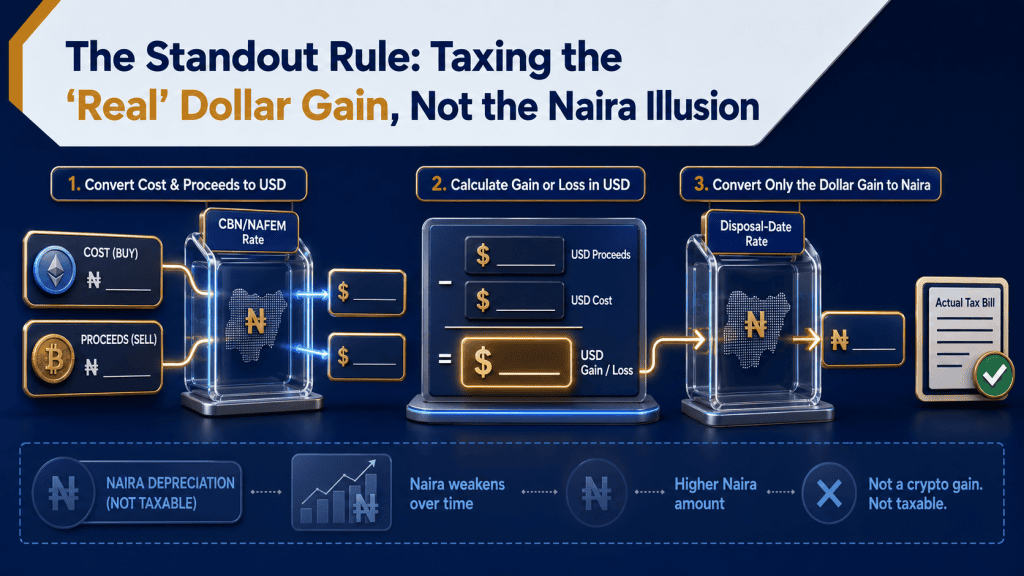
The Standout Rule: Taxing the “Real” Dollar Gain, Not the Naira Illusion
This is arguably the most important, and most taxpayer-friendly mechanism in the whole circular. For cryptocurrencies and other USD-referenced tokens, gains aren’t calculated in Naira. Instead:
- Cost basis and disposal proceeds are both converted to USD at the prevailing CBN/NAFEM rate.
- The gain or loss is calculated in dollars.
- Only that dollar gain gets converted back to Naira — at the disposal-date rate — for the actual tax bill.
What’s Not Taxed
Several common crypto activities are explicitly carved out as non-taxable events:
- Simply holding a VA (no tax on unrealized gains)
- Moving assets between your own wallets
- Locking tokens into staking or validator protocols
- Minting an NFT (tax only kicks in on first sale)
- Tokenizing a real-world asset without a change in ownership
- Receiving loan proceeds secured by VA collateral
- Wrapping/unwrapping tokens (e.g., BTC → WBTC) or depositing into DeFi in exchange for a receipt token (e.g., ETH → stETH) — as long as you retain beneficial ownership
The Compliance Burden Falls Heavily on VASPs
Exchanges and P2P marketplace operators are the backbone of enforcement here. They’re required to:
- Withhold stamp duty and income tax at source, in the native token
- Charge and remit VAT on their service fees
- File regular returns and maintain records for at least six years
- Make a valid Tax ID a precondition for account activation
Even “off-platform” bilateral P2P deals with no intermediary aren’t exempt — they simply shift the compliance burden to annual self-assessment by the taxpayer instead.
Penalties Are Steep for VASPs
Non-compliant VASPs face ₦10,000,000 for the first month of default and ₦1,000,000 for every subsequent month — by far the harshest penalty on the list. Individual taxpayers face smaller but still meaningful fines for late registration, incomplete filings, or poor recordkeeping, plus a 40% penalty on any tax that should have been deducted at source but wasn’t.
The Bottom Line
Nigeria has moved from ambiguity to one of the more detailed VA tax frameworks anywhere, six asset categories, a dollar-referenced gain methodology that shields taxpayers from pure currency depreciation, and a compliance architecture built primarily around VASPs rather than individual taxpayers.